maanantai 4. elokuuta 2014

Working with students

During the past spring semester I found that I really enjoy working with students. I don't like to use the word "teaching" all that much apart from more official context to refer to a generally understood term (like when talking to my boss about careers and such). To me "teaching" automatically signifies a power structure of teacher lecturing and students listening passively.

I have touched on this subject before in my professional oriented blog. The most efficient learning at least to me has been highly involved process with great teachers giving their encouragement and input, but not pouring information down my throat. This has usually required close interaction with the teacher on personal level and project based or problem based learning.

http://www.worksheetlibrary.com/teachingtips/projectbased.html

The problem or project based learning gives students a lot of responsibility and a more personal look on the subject they are learning about. My Waldorf high school project on inheritable diseases in my family tree was a great project to have. It prepared me for project planning, literature mining, showed how untrustworthy interview based data collection is, and really showed that genetics might not be the field for me after all. These are very important lessons for anyone with an interest for science careers.

The Finnish higher education system does need an over haul. There are some great educators who really help students. Sadly there are still some unintentionally bad teachers. Part of this problem might be the requirement of research personnel to teach with very little rewards. Here are some points that could be improved:
  1. Stop lecturing material students can read on their own. This should not be a goodnight story read to an audience. Higher education should build a knowledge base AND help students take the first steps in applying the knowledge to real problems. 
  2. Stop testing for memorization. This causes talented students to wonder if they really deserved that A. And might give false sense of accomplishment for students who in reality cannot use the information in real life problems.
  3. Offer better career advice. This is a huge deal. The employment situation is tricky in many fields especially if you spent years of your education unaware of the different careers you could be preparing for. Having a person with good sources for different career paths help the incoming students, could make their university experience more goal oriented and useful.
As a future potential academic educator I would like to create an environment for students to make their learning personal. There should be opportunities to fail spectacularly in many ways and learn from the mistakes valuable lessons, that perfect situations never offer. In the end I want my students to be better off than I was.

perjantai 31. tammikuuta 2014

Digital learning at Virginia Tech

Digital learning at Virginia Tech


This semester I am taking my last classes. They all use plenty of digital content compared to any of the classes I took in Finland.

Scholar is the digital gateway to all my classes. Every class has its own page and these pages contain the syllabus, assignments, announcements, forums, wiki pages, polls, calendar, and other content for participants.I have found this extremely useful tool both in managing the classes I am assisting in and classes I am taking.


I am a teaching assistant in Mammary Immunology class this semester. I have the opportunity to use the scholar tools to manage the class. I have found that sending reminders via scholar to all students and posting materials have been the most useful features thus far. I would like to add interesting news articles for students to see on the front page to bring a bit of every day dairy and immunology content to their attention.

The on-line class on emerging infectious disease is naturally fully on-line. PowerPoint slides can be printed out and the visiting lecturers have a talk recorded with the power point presentation. This is still a bit passive to my tastes. Maybe because it is a pass/fail class, the content is not as varied. Preparing the Future Professoriate and Modern Pedagogy classes are a whole other story. They both have very interactive in-class formats. Both also require blogging as part of attendance. Forums are also used when needed. The blogs for these classes are designed to start us on professional blogging. This is going to be a kick-start for me to actually write every day in either blogs, forums, or most importantly my thesis.

Here is a link to my professional blog: http://blogs.lt.vt.edu/highoneducation/


lauantai 25. tammikuuta 2014

Preliminary examination and CRWAD


The time has come for me to take the preliminary examination to get promoted from graduate student to PhD candidacy. Preliminary examination should test the graduate students limits of knowledge on the topics relevant to their research and studies. The committee decides if the knowledge base was wide enough or if more classes need to be taken and examination re-taken. Needless to say this is a big deal and a source of stress.
http://www.phdcomics.com/comics/archive.php?comicid=1419

The examination in my case started with 4 days of written exams, one day for each of my committee member. The committee is a collection of people with PhD under their belt, meant to help me in my research and degree. I have one expert in proteomics, department head of dairy science, and two immunologists. This all culminates in an oral examination by the committee. Never have I been so out of my depth. The cross-examination was very challenging and remembering even most basic things was a struggle due to the extreme stress. At least I recalled my own name. Apparently some people knot themselves up so completely, this simple question baffles them. Luckily I passed.

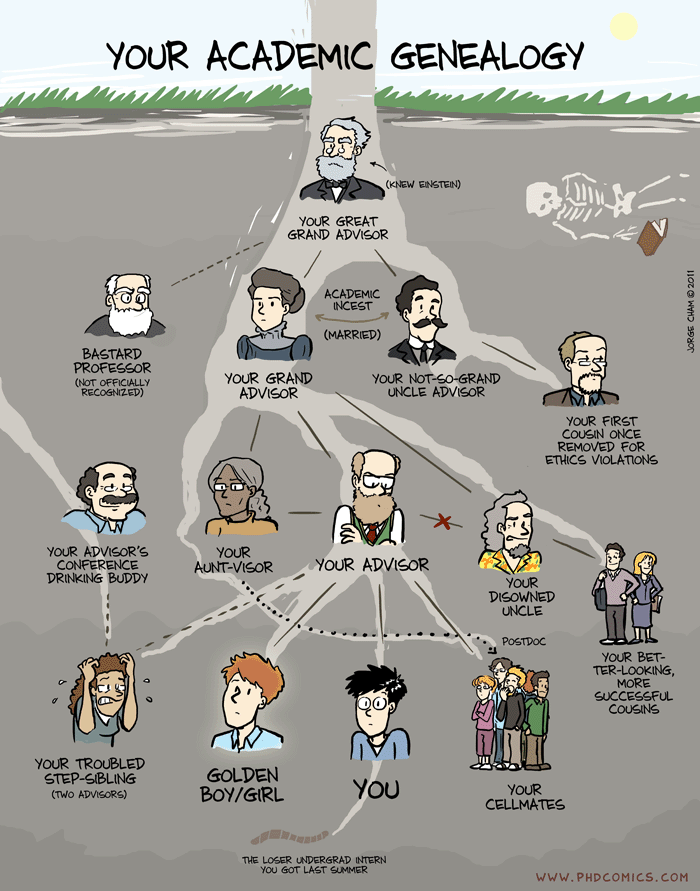
After preliminary examination the yearly CRWAD (Conference for Research Workers in Animal Disease) meeting preparations begun and before Christmas we headed to Chicago for three days. I absolutely loved it. I got to see some people I met last year and hung out with new people between talks. Sadly the boss could not be there this year. Luckily her old PhD adviser took us under her wing. Like an academic grand adviser. This year the poster competition 1st place was mine! And I did not even faint on anyone. According to the lab tradition, after winning 1st place you are no longer allowed to have posters for meetings. Next year I will have to give a talk, which will be a whole new bad off stress. But I am actually looking forward to it.


perjantai 13. syyskuuta 2013

Take a break, for heavens sake!

Take a break, for heavens sake!


Creative thinking required in science requires time. When you get to the final conclusion, the thought "I should have thought of this 6 weeks ago", pops in your head. But you really needed that time personally to get there. The process itself is pleasing, but suffers from outside pressure severely.

When things like hands on research, classes, and training students take up a large part of your day, the space for thought is decreasing rapidly. By large part of the day I mean 10 to 12 hours of the conventional 24 hour day. Naturally sleep takes up 6-9 hours of the traditional day. Thus 3-6 hours per day can be spent not sleeping or working. Commuting to and from work takes up some of this time, something from 30 minutes to a full hour in total per day. Eating is required and god forbid you have a partner, kids, friends, or pets to entertain in addition.

This leads to prioritizing. In the case of graduate students the things that can be moved to a later date can include physical exercise, seeing friends or family, cleaning the apartment, cooking, shopping, blogging, and even taking a shower. I do not follow news actively, I am far behind on all popular TV shows, I had no idea Big Brother is still airing in multiple countries, and what is all the fuss about Robin Thicke? And do I really need to shower today?  This doesn't make me an ideal conversational partner at any bar or normal social gathering. No wonder scientists sometimes seem weird, boring, and foreign to people with 9 to 5 jobs.


As a treat to myself I sometimes leave the lab early in the afternoon. I gather snacks and find an ideal spot in the library on campus. Open my computer, spread articles and pens all over the table to claim the area, and dive in to the topic of my fancy. And it is sad to realize department heads and professors might not get this time due to responsibilities to their lab and department, pointless paperwork, reporting, and family demands.

I consider this precious time for research and thinking one of the greatest privileges of graduate school. And I wish I could gift a few hours of this time to those in demanding leadership positions in academia as well as politics. So please take a break from your day and read something interesting and inspiring, think impossible things, and take advantage of the information available for you.


torstai 18. huhtikuuta 2013

The first official scientific conferences


I attended the Conference for Research Workers in Animal Disease (CRWAD) in Chicago (IL) before Christmas and Virginia Techs Graduate Student Association symposium  last month. I presented my poster in both meetings, and would like to summarize what to do and not to do in a scientific meeting.
  1. Being a short person, wearing high heels makes it easier to look people in the eye. But try to choose comfortable shoes. Standing for 4 hours in one place will hurt your feet.
  2.  At least try to look like you are over 14 years old... (even if it is only to avoid long looks at the bar). So dress professionally.
  3. Locate the bathrooms BEFORE sitting in the middle of the bench row for 3 hours of  talks.
  4. Attend talks and see posters that are not directly connected to your research. We shall branch out like the mold growing under your sink...
  5. Take notes. It is likely you can't remember a single thing after getting back home. And your boss will ask you stuff about the meeting. 
  6. Do not faint during presentation. You will be reminded of the incident for ever. (And if you do, make sure your boss or co-workers are there to catch you, before hitting the hard floor.)
  7. Eat everything offered to you! (everything = edible non toxic products)This will help in avoiding above mentioned situation.
  8. Do not fall asleep during your presentation, at your bosses talk, or during the opening ceremonies.
  9. Do not get the senior scientists drunk, unless you are willing to get them safely back to their hotel.
  10. Talk to people! Even if they seem scary senior scientists, post-Docs or group leaders. They have also been graduate students, so they can relate. And they are really nice...
American Association of Veterinary Immunologists 2012 Student Award winners pictured with Dr. Laura C. Miller (far right).


I really enjoyed these meetings. I got to talk to interesting people and learn about cutting edge science. Also bonding with the fellow graduate students was great. Key element for enjoying the meetings was proper preparation. It also helps if your boss is encouraging and willing to coach you for this. Hopefully can participate in other meetings in the future. Getting inspired by the people I meet there is the best part and cannot be achieved to same extent by staying in your lab or office.


    lauantai 20. lokakuuta 2012

    Summer in Virginia


    What I did this summer:
    1. Research
    2. Research with undergrad
    3. 3 days of holiday
    4. Research
    Research picks up as soon as classes are over. No more undergrads pestering the boss. And data is needed. I swear the cows in our study hate us now. I would too, if someone collected my blood from the jugular twice a week. Summer holidays are for undergrads.

    Having an undergrad research person work with you is a double edged sword. On the other hand you have an extra pair of hands to do stuff. But you have to train the pair of hands. And that pair of hands usually has absolutely no experience in research to begin with. Needless to say, the extra stress broke me down gradually. And I found again that I am not a huge people person under stress.There are lots of things I think I did okay on the training, but also some I will do better next time. It is a bit like training a puppy - consistency being the key. (Although undergrads rarely bite or pee on the carpet.)


    The actual holiday sadly was shadowed with power outage. During the hottest and most humid time of the year. I found that I love air conditioning, warm water, unspoiled food, and electricity. To cool off during these days, Luray caverns was visited. Constant temperature underground was heavenly.

    Hiking the Palisades was fun. Especially since it was really early in the morning and trails were absolutely empty. The water falls were great as usual and the spray felt nice after trekking in the increasing heat and humidity. Apparently the water there is always super cold.

    The environment and nature here are really nice. Rolling hills (at least it feels like hills when you are biking up them), fields and forests. The commercials for travel around here always say "Virginia is for lovers". I can see where it comes from. Although It seems a bit discriminating to singles. The most prominent touristy things of this state are probably the Natural bridge and fake Stonehenge. And of course the coast has beaches and such. Oh and the movie Dirty Dancing was shot here at a hotel up in the hills. 

    I managed few weekends for biking and even an afternoon on the river to relax. Biking here is great. I you do not do what I did. After going down hill at reasonable speed for OVER 30 MINUTES and gawking at the beautiful valley, the uphill part is bound to be horrifying no matter which route you take. And I tried every single route there was, cursing all the way up. Generally it is a bad sign when you see those professional looking bikers go the opposite direction.

    All in all. Summer was awesome.


    maanantai 8. lokakuuta 2012

    Spring semester 2012 over

    The quiet few days after first semester were the calm before storm. And looking back the first semester was ridiculously easy. After class load, research and teaching obligations, there was hardly any time for relaxation (things like preparing food, cleaning, laundry, and sleeping. Oh and updating this blog....).

    Time management was an issue. Big issue. Trying to get everything done in timely fashion caused a lot of stress. The famous spring break of the American schools, known for fun-beach-party-time, is for undergrads. Graduate students work their ass off and put in long days in the lab. With zero days of downtime during the break, any statements following the lines of "hope you had a relaxing spring break", brought on near homicidal rage. 

    On the other hand the courses were mostly useful. And I got a draft of my very own research plan, designed by yours truly, done. But what I really want to write about is academic presentations.

    The first academic longer presentation in departmental seminar was a success. Talking to large crowds seems very scary to begin with. Just add the stress of the department head and all professors attending in the audience, ready to pounce you with difficult questions, and we have a nice cocktail of nerves and sweaty palms. The old performance anxiety lifted its ugly head. And I really had to work to not go for my primary stress response - telling inappropriate jokes and cursing.

    Here are some things that helped me put together a successful academic presentation:
    1. Prepare! Start very early! Like minimum of 3 weeks before the actual date...
      • Do your research on general papers and reviews, but do not dwell on it. Go boldly for the in-depth, hardcore specialized stuff.
    2. Prepare!! 
      • Make up a list of topic sentences - the four to five things you want to really say.
      • To support your message, collect data from your researched articles.
    3. Prepare!!!  
      • Put together the first version on Power point. (Trust me, this is nowhere near the final. You might change 90% of your data on the slides, before you are done.)
    4. Modify
      •  Make it concise
      • Imagine you have stayed up until 2 am (you might not have to imagine this actually...) and are attending this talk at 8am. What would you like to hear and see?
      • Also imagine you are presenting this to people who have attention span of a 4-year-old child. (Hopefully this is only your imagination)
    5. Practice
      • Time yourself
      • If you are saying things, not all of them have to be also read by the audience (at least I am not going to read anyone's slides at 8am after 5 hours of sleep)
    6. Practice more
      •  Find a practice audience. Make sure they are not too nice. They will need to point out your mistakes
    7.  Wear nice clothes
      • Psychological effect on you AND the audience
    Next post will be on what happened during summer..... yay!

    tiistai 27. joulukuuta 2011

    First semester in Graduate school is behind

    It is done. First semester. First time I ever saw a SWAT team. And spent painful four hours trapped in a hotel. And I thought lightning never strikes twice in the same place. The scars of May 16th are still too fresh and first thoughts people had were seriously "not again" when alert systems announced shots being fired.... It is kind of sad how well the whole school was prepared to face this. Even the students had a memorial fund for the killed police officers family up and running the same day. Exams were okay even if conveniently there was that shooting incident just day before they started.

    Americans are very fond of multiple choice questions in exams. And do not be fooled. They are darn hard. With four to six choices for each question and each of them very detail oriented. I miss essays a bit. But the exams went well. And to my knowledge also the writing assignments were not a total disaster either. All in all, now I have a better understanding of how Virginia Tech gets its academic reputation. The amount of truly passionate researchers on all levels of the totem pole is just amazing. This is now my academic home. 


    On a lighter note....I am visiting Alaska for the holidays. Me and my stack of research articles and immunology reading material.... Now this I would call mountainous area. Eagles flying around and all that fresh air would make anyone want to move here. But few days in constant rain and that nonsense is gone out of your mind. At least until the next sunny day. Darn the fish is good and fresh here. And no need to sell your soul for a decent piece of salmon.

    Hoping this restful holiday will lead to a very productive semester on the research front!


    perjantai 18. marraskuuta 2011

    Luxurious week ahead!

    As Thanksgiving is closing up, the hardest four weeks thus far academically are over and week of no classes is ahead. It turns out your standards for luxury lower drastically after entering graduate school. Here are some luxuries that will make me happy during next week of down time:
    1. Getting over 5 hours of sleep per night. (On a side note: lack of sleep really affects your memory. And this is why I will never have children. I would go insane with the lack of sleep.)
    2. Finding time to go to the grocery store every week instead of twice a month.
    3. Looking at your schedule and seeing that there are no insane spurts between buildings to get to class next semester. (I am hoping for this, fingers crossed)
    4. Looking in the fridge and seeing that there is real food instead of stuff scavenged from on campus scientific meeting
    5. Realizing there is no need to run for the bus since it is not leaving that early on holiday schedule
    6. Going to a store that sells a good variety of products that are not food. Walmart, here I come!
    7. Visiting the bank and post office like normal people instead of trying to find a way to do everything online as those places close when you are still normally in class.
    8. Reading the magazines that have arrived to the house during the past month with out skipping paragraphs (even if they are bio technique magazines and commercials for food).
    Alas....this is not a vacation week by any means. I still need to write one huge paper and four short ones. And prepare for finals. It is really true that graduate school in US is rough. Even if you are aware of it, nothing prepares you for the true impact. Luckily you are not the only one in this situation. When complaining about the lack of sleep and other time management issues you can see people nodding, "yes that is how we feel too".

    lauantai 17. syyskuuta 2011

    Getting excited about science!

    While reading an article for journal club presentation I found a new scientific lover in the form of biofilms and their structures, functions, and effects to everyday life. This has happened to me before, but every time it is like falling in love again and again. You want to know all about the object of affection (stalk your crush on Facebook) and spend all your time with them. 

    Science works in same ways to an extent. You feel the need to do multiple internet searches on the topic. PubMed (search engine for scientific publications) suddenly becomes your most visited site. You spend hours better spent sleeping looking for new articles, pictures, statistics and research groups specializing in the topic. If you are lucky and get to actually do some research relating to this topic, you end up spending the incubation times (basically just waiting time) admiring the research material be it a culture of bacteria or theoretical model on computer. (Although one hopes that there is no need to cuddle with the research object unless it is a kitten).

    This is probably one reason some scientists seem so weird to others. They are in their own world. And as true lovers of their topic they can't stop talking about the object of their affection. Everyone has had some form of obsessions as children. This is where the level of interest probably stems from. I will use myself as an example to point out the diversity of interests and that even scientist are just normal people with their intense obsessions. They just managed to make a career out of it.

    Age 6-12:
    Dinosaurs. The best thing ever! I still have a soft spot for prehistoric archeology due to this. It was very common interest for kids due to a movie called Jurassic park. They were large and varied in shape and habits and colors! Just like fairytale creatures, but with the added bonus of them actually being real!  The first story I independently read was a short paragraph depicting tyrannosaurus Rex in a encyclopedia for kids. I am eternally grateful for my parents for taking me to several dinosaur related exhibitions. This must have been very boring to them.
    Age 10-11:
    Space. I had a little notebook filled with notes on planets and stars. Sadly I did not have a telescope at the time. This topic was short lived though as there was a very limited amount of information I could understand at the time from books.

    Age 11-16:
    Art. Creating own paintings and studying artists was a hobby for a long time. True artistic talent was not observed at any point. But still my mother got me all needed supplies and even took me once a week to art club for kids. 

    Age 10-12:
    Egyptology. My interest in the era was rather intense. Books on this topic had lots of pictures and there was even a written language that was based on little pictures. Mysteries, politics, stories, curses and especially the peculiar way to store dead people was fascinating. My mother indulged me by taking me to another city to see an international visiting Egyptology exhibition. Culmination of this interest led me to read a book probably not suitable for a 12-year-old. A huge tome called Sinuhe the Egyptian written by Mika Waltari depicting life of an imaginary person called Sinuhe in Egypt in time of Pharaohs.

    Age 14-17: 
    Plants as experimental organisms. This was a thing for every summer made possible by my fathers farming profession. I could get my hands on seeds actually used for food production and get advice for making them grow for experiments. I learned a lot about experimental design by making tons of mistakes. I obsessively recorded results on the poor plants watered with soap water and constructed a small chart of the results as my last plant related experiment.

    Age 17-19: 
    Genetics and inheritable diseases. High school was a good time to get into some more serious topics. Looking at traits I have against the traits in my immediate family built on junior high and high school information that I found very narrow, with only animal and plant experiments introduced in any depth. I had the chance to get deeper into it in the form of a project in high school that took me via interviews to study the hereditary diseases in my family tree. All the encouragement from my family and relatives went far in obtaining information for the study. 

    sunnuntai 11. syyskuuta 2011

    First taste of Graduate School at Virginia Tech

    Differences between Virginia Tech and the Finnish university system are actually striking. The first week before classes reading assignments were already given. And yes, you actually read the book instead of the notes.  It was stressed that a lot is expected from students from day one. And they actually have great confidence that students will rise to the occasion.

    The university has a honor code that has to be followed at all times. It entails academic integrity and overall moral rules to be followed by all students and staff. It is enforced by a student body based honor court, which handles all cases of suspected cheating and other actions breaking the code like plagiarism. This is unheard of in Finnish university system, although plagiarism has been scanned and there is a moral code followed.

    The situation on graduate students is similar to Finnish system. We are part of the staff and student body, as we have teaching obligations and course requirements. However we are not thrown to the wolves in teaching front. There was a two day course for new graduate teaching assistants before classes started and followup classes involving teaching in academia through out the semester. This ensures better starting point for teaching. This has started to emerge in Finland too, due to its obvious benefits.

    The extra source of stress for graduate students at Virginia Tech is to remain in good academic standing. This in practice means keeping at least B average (3 out of 4 on scale 1-4). This is a challenge due to courses being very demanding and research work being pushed on top of it. This is why time management is considered to be the most challenging part of graduate school.

    The time management part is certainly proving to be an every day challenge with multiple assignments and exam dates piling up. The day I have to think of what to do is still to come. Graduate school is not only about demands on you though. It has already given me the chance to learn from amazing people on top of their fields. This includes the legendary Noel Krieg, one of the editors for Bergey's Manual of Systemic Bacteriology (and he has a bacterial species named after him). I am challenged constantly to do better and think faster and dig deeper. Encouragement and feedback are part of the teaching here all the time and it makes a huge difference in motivating me.

    In words of Dr. McNabb: "You get out of this what you put into it". And I am planning to give this all I can.

    keskiviikko 20. heinäkuuta 2011

    How to get to a graduate school in US

    For me the first hurdle was to decide where I want to study. And I mean really, really WANT to study. "I want to live in New York" is not a good enough reason. This has to matter. You have to want it more than children (given that you want children at all), more than you want a comfy retirement (which you might not get), more than you want  to become a millionare (which you will definately not become anytime soon if you go to grad school). This is no backup plan. This is the wet dream of your academic mind.

    One of the early steps in application process is to ensure good recommendations. My recommendations came from internships and work in US, Australia and Finland during the span of 4 years. Second thing is getting english proficiency test taken and aced. And reviewing excessively snobbish vocabulary for GRE (graduate record examination) with a side of math without calculator. Essays are also important. You sell your self to graduate school. Your pimp is not going to do it for you. Getting an interview is awesome. I prepared for it thoroughly. My interview was actually nice. The questions were not hard and they actually answered some of my questions about the school and program.

    The e-mail I cheris for long time to come arrived a few days later. "YAY! I got in! To Virginia Tech!" This euphoria lasted for a day. Then I took a look at VISA requirements. Being married at this point is not a benefit. A month of stressing out and going through immigration law, VISA laws and personal assets should earn me a minor in immigration law. If I had wanted to study law, I would have gone to a damn law school. All is well that ends well. The VISA interview was fine. The thick stack of paper, trip to Helsinki (15 hours in train) and the two relatively large payments to cover necessary fees (MRV-fee and SEVIS-fee) did not go to waste. There is still no air-con at the waiting room of US consular office, but there you go. You can suffocate and melt in safety behind the armed guards.

    Tie up all loose ends in home country....easier said than done since everything is closed for the summer. I am at the moment loosing my mind over vaccination records.